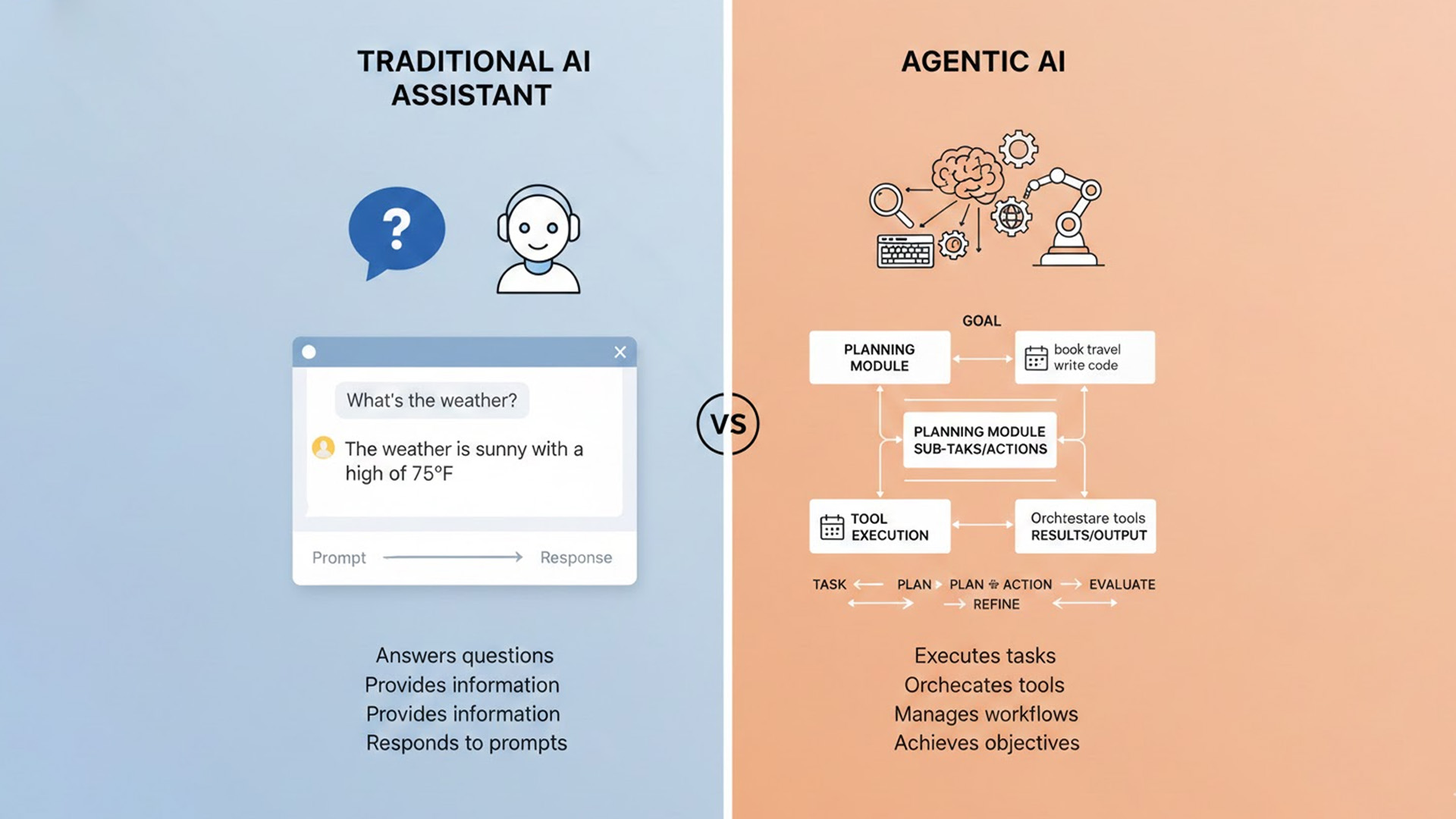
In 2023 and 2024, most “AI assistants” were turbocharged autocomplete. Impressive, but still basically chatbots.
2025 is different.
Gemini 3, GPT-5.1 and Alibaba’s Qwen app are not just answering questions. They are reading your inbox, calling tools, writing and shipping code, orchestrating APIs and moving real money and data around the enterprise. For B2B SaaS, IT leaders and product teams, this is the moment where agentic AI stops being a demo and starts touching core workflows.
This article breaks down:
- What agentic AI actually is
- Why 2025 is the tipping point
- How Google, OpenAI and Alibaba are baking AI agents into search, apps and enterprise tools
- How to evaluate and safely adopt AI agents in your own stack
1. What is agentic AI, really?
McKinsey defines agentic AI as systems based on foundation models that can act in the real world and execute multi step processes.McKinsey & Company
In practical terms, an AI agent is not just an AI assistant that chats. It is a software entity that can:
- Understand a goal in natural language
- Break it into steps and plan
- Call tools and APIs, write and run code, update systems
- Observe results and iterate
- Ask for human approval where needed
Think of the difference like this:
- Traditional AI assistant: “Here are five hotels in Berlin, sorted by rating.”
- Agentic AI: “I found three Berlin hotels that match your policy and budget. I checked availability, picked the best option, booked it with your saved card, added it to your calendar, and filed the receipt in your expenses folder.”
That second version is where Gemini 3, GPT-5.1 and the Alibaba Qwen app are heading.
2. Why 2025 is the tipping point for AI agents
Several signals show that 2025 is the first real AI productivity inflection point for agents in the enterprise.
Adoption and hype (with numbers, not just vibes)
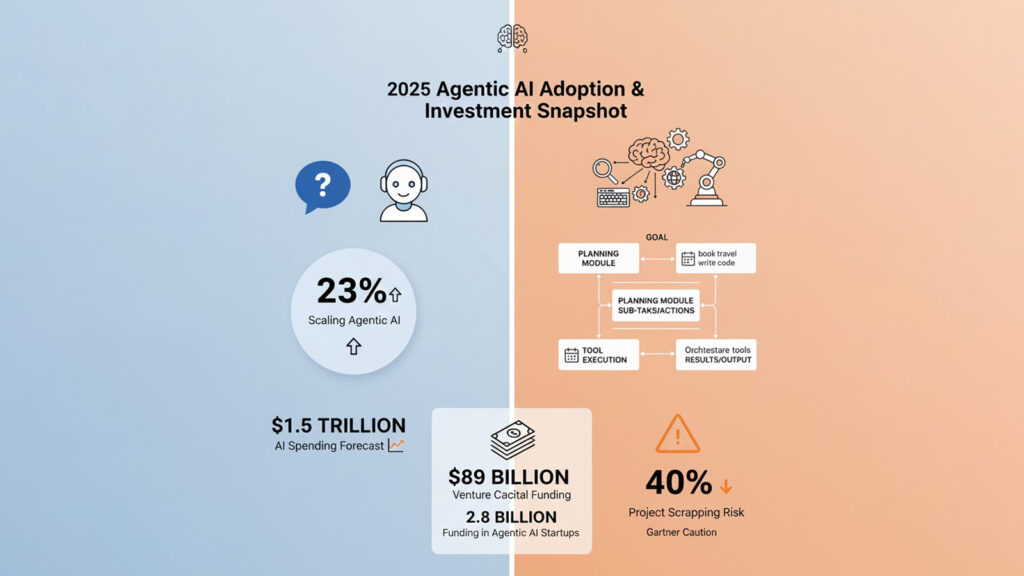
- McKinsey’s 2025 State of AI survey reports that 23 percent of organizations are already scaling an agentic AI system, and another 39 percent are experimenting.McKinsey & Company
- Gartner’s 2025 Hype Cycle for AI lists AI agents and AI-ready data as the two fastest-moving technologies, both at the peak of inflated expectations. Gartner
- Gartner simultaneously warns that over 40 percent of agentic AI projects will be scrapped by 2027 due to cost and unclear value, and that only about 130 vendors actually offer true agentic AI today. Reuters
So the opportunity is real, but there is plenty of agent washing.
Investment and funding
- Worldwide AI spending is forecast to reach 1.5 trillion dollars in 2025.Gartner
- AI startups attracted 89.4 billion dollars in VC in 2025, about 34 percent of all venture capital.SecondTalent
- AI companies still dominate funding cycles, with about 46 percent of startup funding in Q3 2025 flowing into AI.Crunchbase News
- One niche tracker estimates 2.8 billion dollars invested in agentic AI startups in the first half of 2025 alone, driven by autonomous workplace and workflow automation tools. aiagentsdirectory.com
Combine that with McKinsey’s estimate that generative AI could add up to 4.4 trillion dollars in annual economic impact and boost labor productivity growth by as much as 0.6 percent per year. McKinsey & Company+1
Put simply: AI agents are where both boardrooms and venture markets expect the next wave of AI productivity 2025–2030 to come from.
3. Case study: Google Gemini 3 and Gemini Agent
Google’s Gemini 3 launch is the clearest example of a shift from chatbot to agentic AI inside a major ecosystem.
From multimodal model to “universal assistant”
Gemini 3 Pro is a multimodal AI model that significantly improves reasoning and reliability. Google reports more than a 50 percent improvement over Gemini 2.5 Pro in solved developer benchmark tasks, including complex code generation.Google DeepMind
On top of that, the Gemini app is getting deeply agentic features:
- Gemini Agent is described as a new tool that orchestrates and completes complex multi step tasks on your behalf inside the Gemini app.blog.google+1
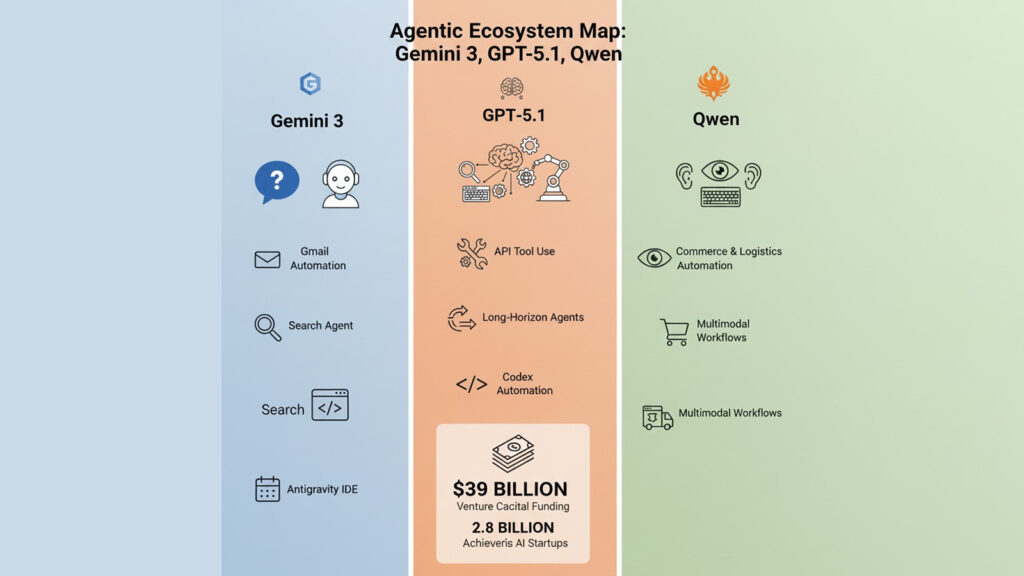
- For Google AI Ultra subscribers, it can organize your Gmail inbox and help with bookings by reading email, extracting structured information and acting across Workspace.blog.google+1
- Google is also integrating its Shopping Graph of about 50 billion products so Gemini can compare products and prices as part of those automated workflows.unwind ai
Reuters reporting highlights that Gemini 3 is being embedded directly into Google Search, and that Gemini Agent can carry out tasks such as organizing inboxes and booking travel arrangements.Reuters This is a textbook example of AI in search becoming AI that acts.
Antigravity: an agent first IDE
Alongside Gemini 3, Google launched Antigravity, an “agent first” coding environment.The Verge+1
Key aspects for technical leaders:
- Multiple AI agents can interact directly with the editor, terminal and browser.
- Agents produce “artifacts” such as task plans, logs and recordings so developers can inspect and verify what happened.The Verge
- A dedicated Manager view lets you orchestrate multiple agents across workspaces, more like a mission control system than a chat window.The Verge
For B2B product teams, the lesson is clear: Gemini 3 is not just a more capable AI assistant. It is a workflow automation engine, embedded into search, email, documents and now development tools.
4. Case study: GPT-5.1 and OpenAI’s agentic stack
OpenAI’s GPT-5.1 release goes in the same direction, with a strong focus on agentic AI and long horizon tasks.
GPT-5.1 as a general purpose agent brain
OpenAI describes GPT-5.1 as a flagship model that balances intelligence and speed for a variety of agentic and coding tasks, with an updated prompting guide geared toward structured workflows rather than single turn Q&A.OpenAI Cookbook
For developers and enterprise AI tools, there are several important features:
- Adaptive reasoning and improved coding performance in the API.OpenAI
- Extended prompt caching so context can stay “hot” for up to 24 hours. This matters a lot for long running agents that manage email triage, knowledge retrieval or complex support cases.OpenAI
- New tools such as
apply_patchandshellthat turn the model into more of an autonomous operator, able to modify code bases and interact with environments programmatically.OpenAI
On the coding side, GPT-5.1-Codex-Max is positioned explicitly for long horizon coding and workflow automation. OpenAI reports that internal engineers who use Codex weekly ship about 70 percent more pull requests, which hints at the productivity ceiling when AI agents handle repetitive development work.OpenAI
The implication for IT leaders is straightforward: GPT-5.1 is designed as a back end for AI agents, not only as a conversational bot. It is optimized to stay in context, call tools, manage state and coordinate across multiple steps.
5. Case study: Alibaba’s Qwen app and workflow agents
In Asia, Alibaba is building a parallel ecosystem around its Qwen models.
- The Qwen AI assistant is marketed as a multimodal AI with strong reasoning and problem solving skills, available to consumers and businesses.Qwen
- Alibaba Cloud’s “Qwen Agentic Deep Dive” highlights a focus on workflow automation through the Qwen LLM and platforms like Dify, particularly for business processes such as operations and marketing.AlibabaCloud
- Reuters reporting notes that Alibaba has launched a major consumer upgrade with a new Qwen chatbot, part of a broader strategic pivot into AI as a core growth driver.Reuters+1
In practice, the Alibaba Qwen app is being woven into commerce, payments and logistics workflows across Alibaba’s ecosystem. For global product leaders, this shows that agentic AI is not just a US centric or Western play. It is becoming a competitive axis across GEOs, with local ecosystems embedding agents deeply into their own cloud, retail and fintech stacks.
6. Common patterns: from chatbots to “embedded agents”
Across Gemini 3, GPT-5.1 and Qwen, several common patterns emerge.
1. Agents are moving inside existing workflows
Instead of standalone chatbots, agents are appearing:
- Inside search results (Gemini 3 in Google Search)Reuters
- Inside email and productivity suites (Gemini Agent in Workspace, GPT-5.1 inside office tools)blog.google+1
- Inside IDEs and dev tools (Antigravity for Gemini, Codex for GPT-5.1)The Verge+1
- Inside vertical apps such as e commerce, CRM, fintech, and health care backed by Qwen and emerging agentic AI startupsAlibabaCloud+1
This is crucial for enterprise AI tools. The agent is no longer another system users must learn. Instead, it lives where work already happens.
2. Multimodal AI is table stakes
All three stacks highlight multimodal AI:
- Gemini 3 reasons across text, images, audio and video, with specific claims about improved multimodal reasoning.Google DeepMind+1
- GPT-5.1 is part of a multimodal product line that powers ChatGPT’s text, image and code experiences in one place.OpenAI+1
- Qwen similarly markets multimodal understanding for diagrams, documents and other content.Qwen+1
For agents that book travel, reconcile invoices or debug infrastructure, the ability to read screenshots, PDFs and logs is now a core requirement.
3. Agents as orchestrators of workflow automation
All three ecosystems present agents as orchestrators rather than isolated bots:
- Gemini Agent coordinates Chrome, Gmail, Calendar, Maps and Shopping Graph to complete booking and organization flows.Reuters+2unwind ai+2
- GPT-5.1 and Codex are explicitly described as designed for “real agentic and coding work” with long running interactions, particularly when combined with updated CLI and IDE tools.OpenAI+1
- Qwen and Dify emphasize multi step, cross system automation for business processes.AlibabaCloud
This is what most enterprises actually want: workflow automation that threads across CRM, ERP, ticketing, data warehouses and internal APIs, not just better chat.
7. How to evaluate AI agents in 2025 (for B2B, IT and product)
Gartner’s warning that 40 percent of agentic AI projects may be scrapped by 2027 is a red flag for buyers.Reuters You need a structured way to evaluate AI agents and vendor claims.
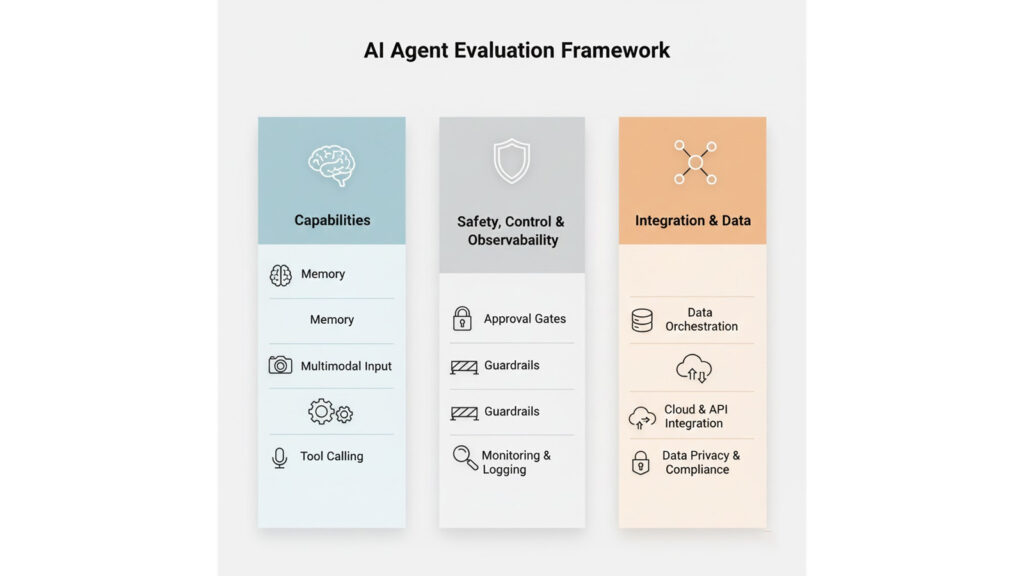
Here is a practical checklist.
A. Capabilities
- Planning and tool use
- Can the agent break down a vague goal into steps?
- Does it have native tool calling and function support, or is it just sending prompts behind the scenes?
- Memory and context
- Does it support long running workflows with persistent memory, like extended caching in GPT-5.1?OpenAI
- How does it store and secure conversation state and decisions?
- Multimodal inputs
- Can it read emails, documents, screenshots, PDFs and logs relevant to your use cases?
B. Safety, control and observability
- Approval gates
- Does the agent queue actions like bookings, purchases and updates for human review, as Gemini Agent does for travel bookings?unwind ai+1
- Traceability
- Are there explicit logs and “artifacts” of agent behavior, similar to Antigravity’s task lists and recordings, to support audit and debugging?The Verge
- Guardrails and policies
- Can IT teams enforce data access rules, rate limits and red lines at the platform level rather than relying on prompts?
C. Integration and data
- Tooling ecosystem
- Gemini 3 explicitly ships with “Day 0” support in open source frameworks like LangChain, LlamaIndex and n8n.Google Developers Blog
- GPT-5.1 sits inside a mature ecosystem of SDKs, connectors and plugins.OpenAI+1
- AI-ready data
- Gartner highlights AI-ready data as a twin priority with AI agents on the 2025 Hype Cycle.Gartner
- Business Insider and McKinsey both emphasize the need to shift from static and siloed data to dynamic, orchestrated data to unlock agentic value.Business Insider+1
If your data is fragmented across systems, your agents will be too.
8. Implementation playbook for enterprise teams
If you are an IT leader or product manager, here is a realistic way to adopt agentic AI in 2025 without falling into the hype trap.
Step 1: Pick one or two “needle-moving” workflows
Look for workflows that are:
- Repeatable and rules-driven enough to standardize
- Painful today in terms of time or cost
- Safe to sandbox with human approval loops
Examples:
- Level one support triage and escalation
- Sales email drafting and follow-ups
- Invoice and expense processing
- Dev environment setup and test automation
Step 2: Map the data, access, and tools
For each workflow, document:
- Systems involved (email, CRM, ticketing, databases)
- Required permissions and compliance constraints
- Tools and APIs the agent must call
This step is boring but non-negotiable. Agentic AI fails most often because it cannot see or act on the right systems in a controlled way.
Step 3: Choose your stack and GEO strategy
- If you are heavily invested in Google Workspace and Search, a Gemini 3 plus Gemini Agent strategy may minimize integration friction.
- If you need maximum flexibility and deep coding workflows, GPT-5.1 with Codex in your own IDEs and infrastructure may fit better.
- If you operate primarily in China or Southeast Asia, the Alibaba Qwen app and Qwen cloud ecosystem may align better with local regulations and infrastructure.AlibabaCloud+2Reuters+2
You do not need to pick only one. Many organizations will end up with a polyglot agentic stack where different agents specialize in different domains.
Step 4: Design human in the loop and governance from day zero
- Set explicit thresholds for when the agent can act autonomously and when it must request approval.
- Define incident response processes for incorrect actions.
- Ensure your AI governance operating model is clear, including roles for security, legal and risk teams, as McKinsey links clear oversight to higher value capture.McKinsey & Company+1
Step 5: Measure AI productivity, not demos
Track tangible impact:
- Time to resolve tickets
- Time from spec to merged pull request
- Sales response times and win rates
- Errors prevented by approval gates
Tie these to a simple business case. This is how you avoid becoming part of the 40 percent of scrapped projects Gartner anticipates.Reuters
9. Future outlook: 2028 and beyond
Gartner estimates that by 2028:
- 15 percent of day-to-day business decisions will be made autonomously by agentic AI
- About one third of enterprise software applications will embed AI agents, up from only a small single-digit share in 2024Reuters+1
If that plays out, most knowledge workers will interact with AI agents as routinely as they interact with email today.
Combined with the multitrillion-dollar productivity opportunity sized by McKinsey, McKinsey & Company+2McKinsey & Company+2, the message for B2B SaaS and IT is straightforward:
- Agentic AI is not a feature. It is a platform shift.
- Ecosystem leaders like Google’s Gemini 3, OpenAI’s GPT-5.1, and Alibaba’s Qwen are racing to become the default AI assistants and AI agents embedded into the tools your teams already use.
- Your competitive advantage will come from how quickly and safely you redesign workflows, data, and products around these capabilities.
10. Quick FAQs for IT leaders and product managers
Is agentic AI ready for mission-critical workflows?
Partly. The tech can already automate large chunks of customer service, coding, and back office operations, as Gemini 3 and GPT-5.1 show.Google DeepMind+2OpenAI+2 However, Gartner’s data shows that many early projects fail due to poor scoping, weak data and unclear ROI. Start with constrained, high value use cases and strong human oversight.Reuters
How should we think about build versus buy?
You will likely do both. Use vendor agents such as Google Gemini Agent or the Alibaba Qwen app where they already sit inside your stack. Then build custom agents on top of platforms like GPT-5.1 or Gemini 3 for your most strategic workflows and proprietary data.blog.google+2OpenAI+2
What skills will my team need?
Beyond prompt engineering, you need:
- Strong understanding of your internal data flows
- Secure API and event driven architectures
- Monitoring and observability for agents
- Governance and risk management
These are classic software and data engineering skills, applied to a new pattern.
If you are planning your AI roadmap for 2025, the key question is no longer “Which chatbot should we roll out?”
The better question is: Which three workflows will we hand to AI agents first, and which ecosystem will we bet on for them to run?